Software News

- A new release of the PEPA Eclipse Plugin is now available. Version v25 of the PEPA Eclipse Plugin provides support for capacity planning for PEPA models.
- This release is up-to-date with the latest versions of Java and Eclipse, making new analysis capabilities for PEPA available on the latest platforms.
- The PEPA Eclipse Plugin can be downloaded from the downloads page.
QUANTICOL

- The main objective of the QUANTICOL project is the development of an innovative formal design framework that provides a specification language for collective adaptive systems (CAS) and a large variety of tool-supported, scalable analysis and verification techniques..
- In this project, PEPA and its extensions have been used to construct formal models of the bus transport systems to study their resource provisioning.
- The project home page is here
The XXL Project
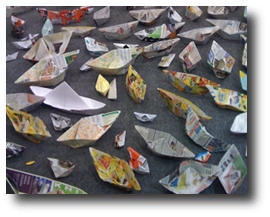
- The XXL project (Advanced Tools and Techniques for the Specification and Verification of Systems with Elevated Granularity) has used PEPA to model emergency egress where people need to evacuate from buildings quickly in case of fire or other emergencies.
- Models were built in PEPA and evaluated using the PEPA Eclipse Plug-in, making use of its ability to analyse systems with very large state-spaces.
- More details on the work appear in the papers Reconciling Population and Agent Models for Crowd Dynamics and A Scalable Fluid Flow Process Algebraic Approach to Emergency Egress Analysis.
- The PEPA models are available on-line here.
SENSORIA

- The development of the PEPA Eclipse Plug-in was supported by the four-year European project, SENSORIA (Software Engineering for Service-Oriented Overlay Computers).
- The SENSORIA project provided funding for the development of the PEPA Eclipse Plug-in and the XSP query language for PEPA, but it also provided the significant technical challenge of modelling service-oriented computing, large-scale systems where computing resources are bound at run-time.
- This provides a number of challenges for quantitative modelling which we addressed through SRMC (The SENSORIA Reference Markovian Calculus), a structured process calculus for service-oriented computing which compiles to a set of PEPA models.
Software
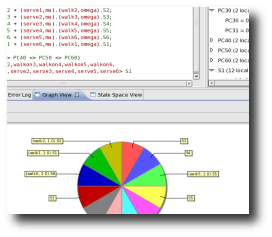
- The PEPA Eclipse Plug-in is a development environment for PEPA, supporting Markovian analysis, continuous-space analysis and simulation. The PEPA Eclipse Plug-in is available for free download from the download page.
- For passage-time analysis the International PEPA Compiler provides a sophisticated query language for probing PEPA models to obtain response-time distributions along passages of interest through the model's behaviour. The International PEPA Compiler is available for free download from the download site.
- A LaTeX style file for PEPA is available (example). A Beamer LaTeX theme file for PEPA is available.
- logopepa can be used on Linux systems to generate PEPA logos in a variety of graphics formats, see "logopepa --help" for details.
Visit us
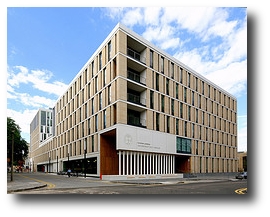
- The PEPA group are based in the Informatics Forum in Crichton Street, Edinburgh. The Informatics Forum is an exciting venue for our work on stochastic process algebras. It is located in the heart of Edinburgh city. Take a video tour of the Forum.
- Come and visit us! The PEPA group welcomes visitors interested in stochastic process algebra, performance modelling, simulation and other methods of quantitative analysis. We have plenty of office space in our beautiful new building and are happy to host visitors.
- Are you interested in doing a PhD on PEPA? We always welcome applications from interested students. Please send email to Jane.Hillston at ed.ac.uk in the first instance.
Awards
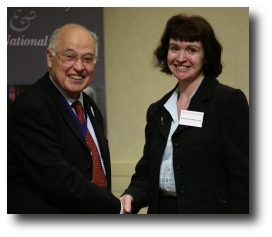
- Congratulations to Professor Jane Hillston, personal chair in quantitative modelling at The University of Edinburgh and inventor of the PEPA language, who was made a Fellow of the Royal Society of Edinburgh at their award ceremony on 30th April 2007.
- Congratulations to Richard Hayden of Imperial College, London who was presented with the Microsoft Research Award for the Best Computational Science Student at the Science, Engineering & Technology Student of the Year awards held in Alexandra Palace London in September 2007. Richard won the award for his dissertation on PEPA, Addressing the state space explosion problem for PEPA models through fluid-flow approximation.
Selected recent papers
- Fluid flow approximation of PEPA models, Jane Hillston, QEST 2005
- Modelling the influence of RKIP on the ERK signalling pathway using the stochastic process algebra PEPA, Muffy Calder, Stephen Gilmore and Jane Hillston, TCSB 2006
- Evaluating quality of service for service level agreements, Allan Clark and Stephen Gilmore, FMICS 2006
- Stronger computational modelling of signalling pathways using both continuous and discrete-state methods, Muffy Calder, Adam Duguid, Stephen Gilmore and Jane Hillston, CMSB 2006
- Location-aware quality of service measurements for service-level agreements, A. Argent-Katwala, J. Bradley, A. Clark, and S. Gilmore, TGC 2007
- Evaluation of RSVP and Mobility-aware RSVP Using Performance Evaluation Process Algebra, H. Wang, D. Laurenson and J. Hillston, ICC 2008.
- State-Aware Performance Analysis with eXtended Stochastic Probes, Allan Clark and Stephen Gilmore, EPEW 2008
( ... all PEPA papers, ... PEPA bibliography )
New to PEPA?

The following papers provide an introduction to PEPA and the concepts involved.
- Tuning systems: From composition to performance, Jane Hillston, Computer Journal, 2005
- Process algebras for quantitative analysis, Jane Hillston, LICS 2005
About PEPA
Jane Hillston's PEPA is a stochastic process algebra which is used for modelling systems composed of concurrently active components which co-operate and share work. PEPA allows the modeller to study either behavioural or performance properties. This archive gives access to papers on PEPA, example models, and software tools which support the PEPA language. A LaTeX style file for PEPA is available (example). A TrueType font for PEPA is available.
Pronunciation: PEPA is pronounced Pep-Ah, not Pea-Pah or Pay-Pah.